


Vishwa Sutra
Syllabus: GS1/ Culture
In News
- The Vishwa Sutra collection debuted at the 61st Femina Miss India in Bhubaneswar.
About
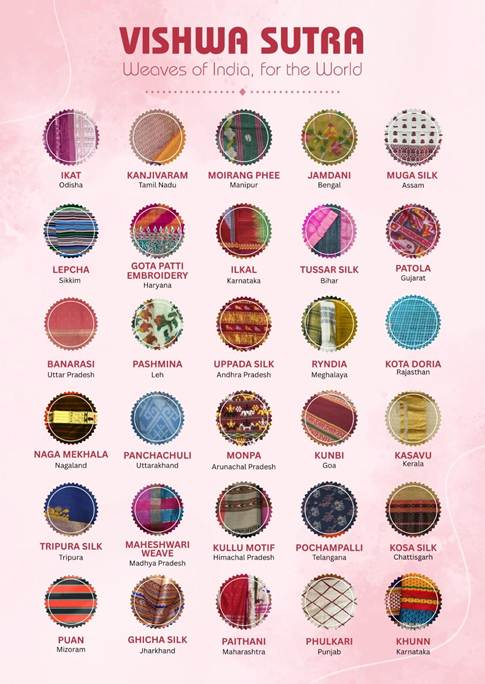
- Vishwa Sutra is a designer handloom collection jointly developed by the Office of the Development Commissioner (Handlooms) under the Ministry of Textiles, and the National Institute of Fashion Technology (NIFT).
- It pairs 30 state-specific Indian weaves with the cultural aesthetics of 30 nations positioning traditional handlooms within a modern, global design language.
Key Features
- The 30-30 Framework: Each of the 30 state winners at the Miss India pageant presented one state-specific weave inspired by a distinct country’s design sensibility.
- Kunbi Weave Highlight: The 61st Femina Miss India winner wore the Kunbi weave, a Goa-origin weave symbolising family and seed reimagined as a Central European skirt silhouette.
Significance
- 5F Vision: Directly operationalises the PM’s framework — Farm → Fibre → Factory → Fashion → Foreign
- Vocal for Local to Global: Transforms traditional cottage-level weaving into an internationally competitive fashion proposition
- Soft Power: Uses textiles as a medium of cross-cultural diplomacy and storytelling on a global stage
Source: PIB
Jagadguru Basaveshwara
Syllabus: GS1/Culture
Context
- Prime Minister Narendra Modi paid homage to Jagadguru Basaveshwara on the occasion of Basava Jayanthi.
About
- Basaveshwara, also known as Basavanna, was a 12th-century philosopher, social reformer, and key figure of the Bhakti movement, primarily active in the Kalyana region of present-day Karnataka.
- He is regarded as the founder of Lingayatism and advocated equality, social justice, and the rejection of caste hierarchy and social discrimination.
- Lingayats had been classified as a Hindu subcaste called “Veerashaiva Lingayats” and they are considered to be Shaivites.
- He served as a minister under King Bijjala II of the Kalachuri dynasty, and his teachings are preserved in poetic compositions known as Vachanas.
- Basaveshwara introduced the concept of Ishtalinga, promoting a direct and personal connection with the divine, transcending social divisions.
- He also established the Anubhava Mantapa (often referred to as the first Parliament of the world), a pioneering forum for open dialogue, where people from diverse backgrounds, including women, could participate in discussions on spiritual and social issues.
Source: DDNews
RELOS Pact
Syllabus: GS2/ IR
In News
- India and Russia have operationalised the Indo-Russian Reciprocal Exchange of Logistics Agreement (RELOS) Pact.
About
- The agreement establishes standardised procedures for dispatching and hosting military units between the two countries during authorised activities.
- It defines the administrative, logistical, and operational arrangements required when forces of one country are temporarily present on the territory or within the airspace of the other.
- RELOS is not a permanent basing agreement (remain in effect for 5 years and can be extended), it is a logistics support framework enabling reciprocal access to facilities during exercises, deployments, humanitarian missions, and disaster relief operations.
Source: ET
Cabinet Extends Pradhan Mantri Gram Sadak Yojana-III (PMGSY-III)
Syllabus: GS2/Government Initiatives
Context
- The Union Cabinet has extended the Pradhan Mantri Gram Sadak Yojana-III (PMGSY-III) beyond March 2025 till 2028–29, increasing the outlay by ₹3,727 crore to ₹83,977 crore.
About PMGSY
- The Pradhan Mantri Gram Sadak Yojana (PMGSY) is a 100% Centrally Sponsored Scheme, under the Ministry of Rural Development, aimed at providing all-weather road connectivity to unconnected habitations in rural areas as part of a broader poverty reduction strategy.
- Launched in 2000, the PMGSY has evolved through multiple phases:
- PMGSY-I (2000) focused on providing connectivity to unconnected habitations;
- PMGSY-II (2013) aimed at upgradation of existing rural roads;
- After these two phases, another component of the PMGSY—Road Connectivity Project for Left Wing Extremism Affected Areas (RCPLWEA)—was launched in 2016 for constructing rural roads in the LWE areas;
- PMGSY-III (2019) focuses on consolidation of rural road networks;
- and PMGSY-IV (2024–25 to 2028–29) aims to provide connectivity to about 25,000 newly eligible habitations due to population growth.
Significance
- The extension will help complete targeted rural road upgradation, improving market access for agricultural and non-farm products while reducing transportation costs.
- It will enhance access to education and healthcare services, particularly in remote areas, and contribute to inclusive growth by bridging the rural–urban divide in line with the vision of Viksit Bharat 2047.
Source: PIB
Israel’s ‘Yellow Line’ in Southern Lebanon
Syllabus: GS2/ IR
Context
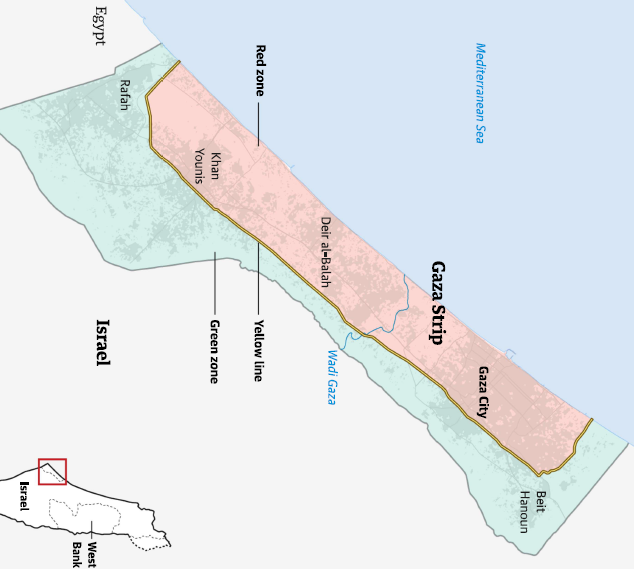
- Recently, Israel announced the establishment of a ‘Yellow Line’ in southern Lebanon, shortly after a 10-day ceasefire agreement between Israel and Lebanon.
What is the ‘Yellow Line’?
- It is a military demarcation line created by Israel to separate areas of control in a conflict zone.
- It is a temporary operational boundary that marks the limit of Israeli troop deployment.
- A threshold beyond which movement is treated as a potential security threat.
Comparison with Gaza
- A similar line has been used in Gaza since October 2023.
- There, it effectively divided territory between Israeli-controlled areas and Hamas-controlled zones.
- Its use in Lebanon reflects Israel’s attempt to replicate a familiar operational strategy.
Bharat Maritime Insurance Pool (BMI Pool)
Syllabus: GS3/ Economy
Context
- The Union Cabinet has approved the creation of a ‘Bharat Maritime Insurance Pool’ (BMI pool) with a sovereign guarantee of ₹12,980 crore to strengthen India’s maritime trade resilience.
About
- The BMI Pool is a domestic insurance mechanism providing comprehensive coverage across key segments such as hull and machinery, cargo, protection and indemnity (P&I), and war risk.
- It covers Indian-flagged and Indian-controlled vessels, including those operating in conflict-prone international waters, and extends protection to cargo movement between India and global ports.
- It is aligned with Maritime India Vision 2030 and supports India’s ambition of becoming a leading maritime nation by 2047.
- Similar state-backed frameworks exist in countries such as the United Kingdom, Japan, and South Korea.
Do you know?
- India’s maritime sector handles over 70% of the country’s trade by volume and nearly 95% by value, yet insurance coverage for this vast ecosystem has largely remained in foreign hands.
- This structural vulnerability became evident during recent disruptions in key shipping corridors such as the Red Sea, Strait of Hormuz and the Gulf of Oman, when several global insurers sharply increased premiums or withdrew coverage altogether, exposing Indian exporters and shipping operators to heightened financial risk and operational uncertainty.
Source: PIB
India’s First Large-Scale Private Gold Mining Project
Syllabus: GS3/ Economy
In News
- The launch of India’s first large-scale private gold mine at Jonnagiri, Kurnool district, Andhra Pradesh, has brought renewed focus on India’s gold reserves, production deficit, and the strategic importance of domestic mining.
About
- Gold is a soft, dense, highly ductile, and corrosion-resistant precious metal found in nature in its native form.
- Gold is India’s second-largest import after oil, with nearly 1,000 tonnes imported annually to meet domestic demand.
- Bihar dominates reserves at ~43%, followed by Rajasthan (~25%) and Karnataka (~20%), while Kerala holds significant placer (alluvial) deposits along its rivers and coast.
- Karnataka accounts for approximately 97% of India’s total gold output, primarily through the Hutti Gold Mines in Raichur.
- China leads global gold production with approximately 10% of world output, followed by Russia and Australia.
- Switzerland is the world’s largest gold importer. Switzerland dominates global gold exports as well, refining approximately 70% of the world’s gold.
Source: TOI
Farmer Producer Organisations
Syllabus: GS3/ Economy
Context
- Farmer Producer Organisations (FPOs) have emerged as a vital collective mechanism to empower small and marginal farmers, and in strengthening India’s food security.
Farmer Producer Organisations (FPOs)
- A Producer Organisation (PO) is a legal entity formed by primary producers, viz. farmers, milk producers, fishermen, weavers, rural artisans, craftsmen.
- A PO can be a producer company, a cooperative society or any other legal form which provides for sharing of profits/benefits among the members.
- The Small Farmers’ Agribusiness Consortium (SFAC) plays a key role in promoting FPOs in India.
- Producer Organisation can be registered under any of the following legal provisions:
- Cooperative Societies Act/ Autonomous or Mutually Aided Cooperative Societies Act of the respective State
- Multi-State Cooperative Society Act, 2002
- Producer Company under Indian Companies Act, 1956, as amended in 2013
- Section 25 Company of Indian Companies Act, 1956, as amended as Section 8 in 2013
- Societies registered under Society Registration Act, 1860
- Public Trusts registered under Indian Trusts Act, 1882
Need for FPOs
- Small farmers face low bargaining power and lack economies of scale due to fragmented landholdings.
- Presence of multiple intermediaries reduces farmers’ share in the final consumer price.
- FPOs enable:
- Aggregation of produce and inputs, reducing costs.
- Improved market access and price realisation.
- Stronger bargaining power with buyers and suppliers.
Source: DTE
Previous article
Gene Drives Transforming Malaria Control
